
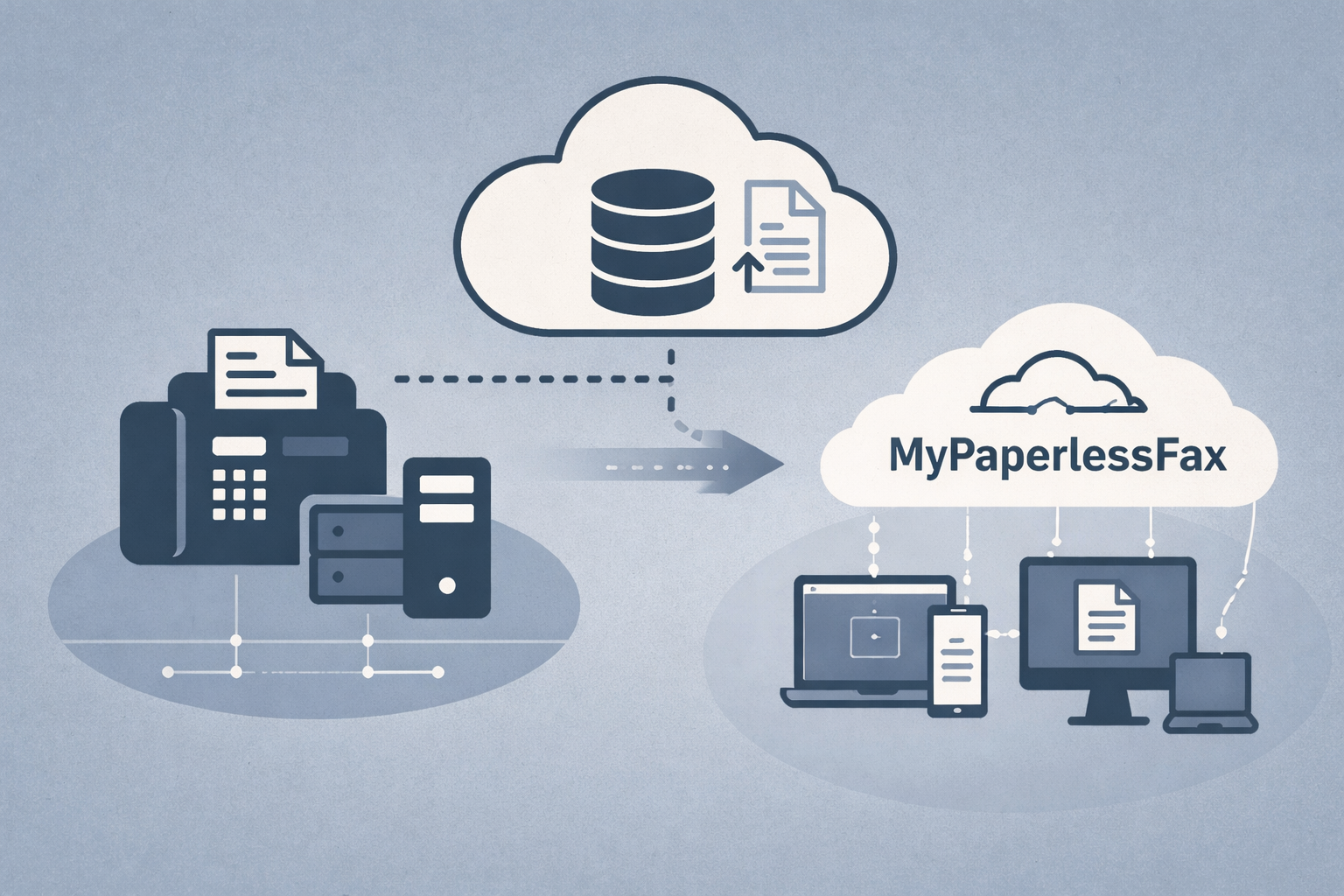
Legacy fax environments are becoming unsustainably expensive. This is the year to build a modernization roadmap before hardware, carriers, or staffing constraints force your hand.
Enterprise fax is entering a transition period.
Many organizations still rely on infrastructure built a decade or more ago, when telephony, staffing, and compliance expectations looked very different. At the same time, reactive fixes create new risks. Fax platforms rarely operate in isolation, so changes in one component can ripple into failures, downtime, or compliance exposure.
Cloud fax modernization is often framed as a migration problem—moving infrastructure from on-prem servers to cloud platforms. In practice, the harder challenge is integration. Fax platforms connect to EHR systems, telephony infrastructure, document management systems, and dozens of operational workflows. Any modernization effort must preserve those connections while infrastructure evolves. In practice, this involves three coordinated decisions:
Organizations generally have three viable architectural paths.
Some cases necessitate an on-prem RightFax environment. It’s less common these days, but usually arises because of strict data residency requirements or highly sensitive workflows. Under those constraints, modernization focuses on replacing aging hardware, updating operating systems, improving monitoring, and transitioning telephony to SIP-based services.
This approach preserves existing integrations and routing logic but leaves the organization responsible for telephony transitions, hardware lifecycle management, and specialized operational expertise.
Hybrid architecture allows organizations to keep their existing fax servers while shifting selected components—often telephony or overflow capacity—to the cloud.
This approach reduces carrier risk and adds scalability while minimizing disruption to established workflows. Many organizations use hybrid deployments during migration periods, allowing workloads to shift gradually rather than all at once.
Hybrid environments work well when internal teams retain telephony expertise or when external specialists support the transition.
A full migration moves fax workloads from on-prem infrastructure to cloud platforms or managed RightFax environments.
In these models, the cloud platform or service provider takes on infrastructure maintenance, scaling, and monitoring. The end customer org retains control over security policies, integrations, and governance while reducing operational overhead.
We generally recommend managed private deployment for higher-volume fax users in healthcare or other regulated sectors. It’s a good balance of the scale and hands-off management of cloud solutions vs. the absolute control of on-prem RightFax—exactly the idea behind Private Fax Cloud®.
Start with a complete inventory of fax servers, versions, modules, and integrations. Map telephony paths across PRI, analog, SIP, SBCs, and UC platforms. Capture a workflow owner for each integration point. Flag single points of failure, end-of-support hardware, orphaned scripts, and carrier dependencies. Set availability and disaster recovery expectations for each solution component.
This is a considerable upfront effort, but it pays off with a clear understanding of scope and risk, which underpins the migration roadmap.
With goals agreed upon, start mapping requirements to the strategic options above. Begin with a pilot and expand in phases, validating routing accuracy, success rates, and throughput at each step. It goes without saying that compliance controls (data residency, encryption, user auth, etc.) must be verified before moving production traffic.
In healthcare, RightFax integrations are often mission-critical. In most cases:
Consequently, cloud deployments must start by replicating existing routing rules, number assignments, delivery confirmations, and so forth before introducing improvements. That’s not only true in healthcare, of course, but the stakes are uniquely high given the human dependencies.
It’s also common for organizations to run multiple fax servers by design. Moving to the cloud doesn’t strictly require consolidating them, least of all on day one. Workloads can be segmented by department, application, or number range and migrated gradually as teams gain confidence in the new environment.
Legacy applications can continue using familiar print-to-fax interfaces or existing integrations, while newer systems begin adopting REST API-based connections. Over time, centralized reporting across both cloud and on-prem environments helps close visibility gaps and creates a foundation for further modernization.
A durable fax strategy leaves room for change. Modular architectures, API-based integrations where they make sense, and cloud-compatible telephony make it easier to adapt as volumes, systems, and integration patterns evolve. The goal isn’t to predict every future requirement, but to avoid locking the organization into another rigid infrastructure cycle.
Security and compliance also need ongoing attention. Regular risk assessments, configuration reviews, penetration testing, and clearly defined PHI-handling policies help maintain audit readiness as platforms and integrations change over time.
Vendor choice plays an important role as well. The most effective partners understand both legacy fax environments and modern cloud architectures. They can help organizations navigate telephony changes, evolving integration methods, and the practical realities of running fax at enterprise scale.
With a thoughtful roadmap, organizations can reduce telephony risk, preserve existing integrations, and modernize fax infrastructure without disrupting critical workflows.
If you’d like help assessing your current environment or planning a phased cloud fax strategy, contact us to review your architecture and get help with the transition from planning through implementation.