
For most organizations, no workflow is more familiar than Microsoft 365 (formerly Office 365) email.
RightFax (now OpenText Fax) integrates with Microsoft 365 to let users send and receive faxes through Outlook and Exchange Online.
RightFax is a leading enterprise fax solution for Microsoft 365 integration. It connects through supported email gateways and connectors developed by OpenText, so users can fax with a single click from right inside their email client.

RightFax supports several methods of connecting with Microsoft 365. Your RightFax version, Exchange architecture, Outlook client, and security requirements will determine the best option.
The RightFax SMTP Gateway lets users fax from email with interacting directly with the fax server. Outbound messages are routed from the email platform to RightFax, which processes and transmits them as faxes, and incoming fax are handled in the reverse order. We often recommend this approach to organizations that need streamlined email-to-fax functionality as opposed to deeper Outlook integration.
OpenText also documents OAuth configuration for its SMTP/POP3 Email Gateway with Exchange Online. The appropriate authentication and mail-flow configuration depends on the specific gateway and Microsoft 365 tenant settings. See OpenText's SMTP/POP3 Email Gateway OAuth configuration guide for more information.
The RightFax Connector for Microsoft Exchange lets users can prepare messages, select recipients, attach documents, and check fax statuses all within Outlook.
Older RightFax deployments may still use the Exchange Web Services (EWS) Connector. However, Microsoft began retiring the EWS API in October 2026 and plans to disable it completely in the coming months. If this is your organization, then contact us to verify your migration path.
Once the integration is configured within Microsoft 365 and within the RightFax server, faxing becomes as easy as email.
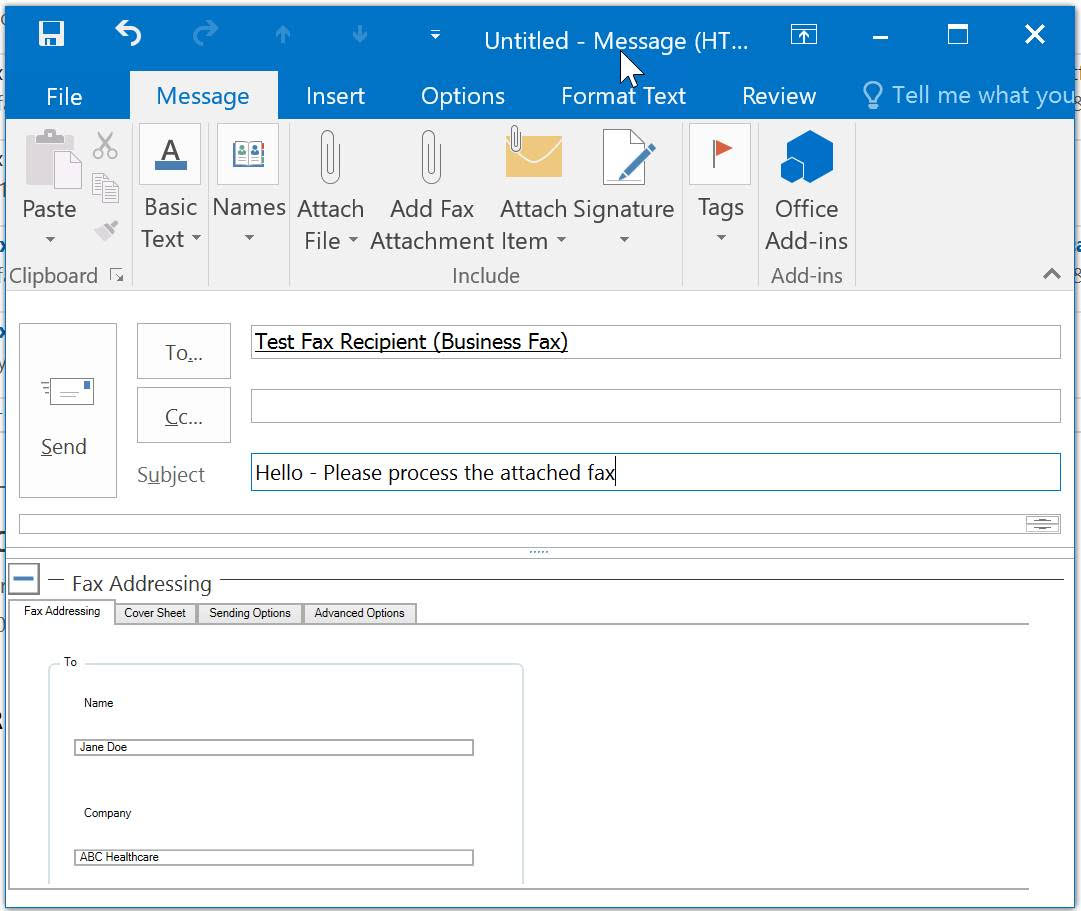
Incoming faxes can also be routed to Outlook inboxes, shared mailboxes, or other destinations based on the organization's workflow.
This enables familiar steps like looking up contacts and attaching files. Recipient validation and standardized cover sheets can also help reduce errors, including faxes sent to incorrect numbers or missing important information.
The exact steps for end users depend on your email infrastructure.
Whatever your email configuration, your Paperless Productivity® consultant will identify the right way to incorporate RightFax.
Before configuring the connection, you'll need to verify a few RightFax and Microsoft 365 prerequisites:
For SMTP-based configurations, Microsoft documents several supported email delivery methods with different authentication and networking requirements. Refer to Microsoft's application and device email configuration guide for technical details.
Issues between RightFax and Microsoft 365 email usually involve authentication, mail routing, connector compatibility, or user configuration.
Authentication may fail when OAuth permissions, application credentials, or tenant settings are incorrect. Older configurations can also stop working when Microsoft retires authentication protocols or APIs.
For SMTP AUTH, administrators check whether the required authentication method is supported and enabled for the relevant mailbox. See Microsoft's SMTP AUTH documentation for details.
If users can compose fax messages but transmission fails, check the email routing path, fax addressing format, connector services, and RightFax transmission logs.
First off, determine whether the message reached RightFax. A message rejected by Exchange is a very different problem from a fax that is accepted by RightFax but fails in the telephony layer.
Check the recipient's RightFax routing configuration, mailbox mapping, Exchange mail-flow rules, and message delivery logs. Separating fax receipt from email delivery helps identify whether the problem originates in RightFax or Exchange Online.
An add-in may be unavailable or behave differently across Outlook versions. The simplest step (and a good preventive measure) is to make sure the installed RightFax release supports the relevant Outlook desktop or web client. Keep in mind that some legacy integrations also depend on Outlook Cached Exchange Mode.
A host of issues can arise after moving from on-prem Exchange to Exchange Online. They often—though not always—involve authentication, routing, and connector discrepancies (not to mention the soon-to-be-retired EWS API as noted above).
Microsoft 365 and Exchange Online are some of the most common RightFax integrations we implement for enterprise clients. When done right, they make faxing seamless, modern, secure, and highly cost-effective.
Whether you're planning a RightFax deployment, Microsoft 365 migration, or standalone project, we can have your users up and running quickly and with minimal interruption.
Contact us today to review workflow options, verify system requirements, and prepare for a fast and smooth integration.