
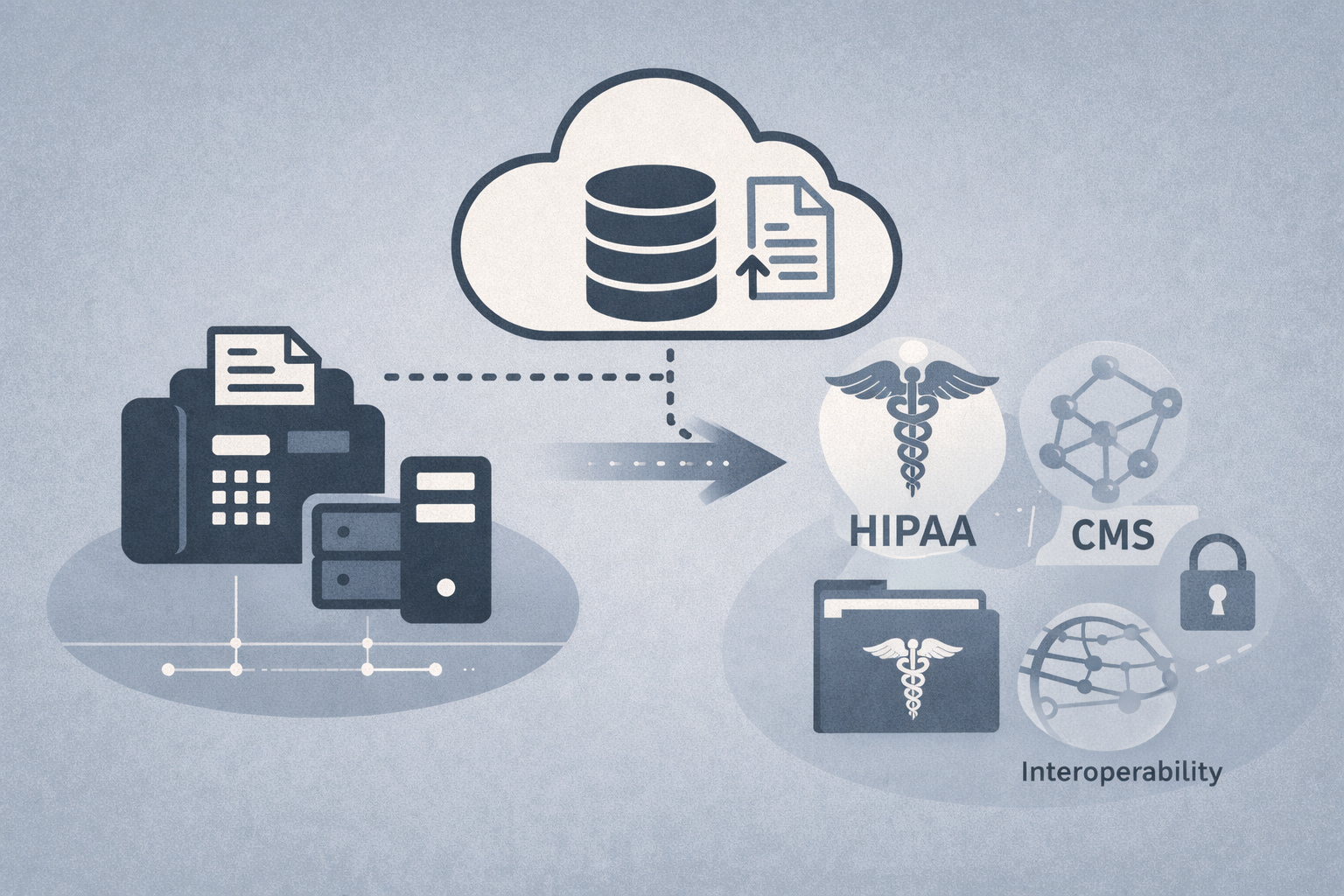
Fax is functionally a regulated ePHI system. In 2026, manage it accordingly.
Fax remains deeply embedded in healthcare operations. Referrals, prior authorizations, diagnostic orders, and clinical results frequently move through fax channels even as the industry pushes toward API-based exchange.
Progress toward fully standardized interoperability has been uneven. Many organizations still rely on fax because it is universally supported, relatively secure, and operationally reliable across disparate systems.
However, reliance on fax now comes with clearer expectations. In 2026, healthcare organizations are expected to manage fax platforms with the same governance applied to other systems that store or transmit electronic protected health information (ePHI). That level of governance requires organization-wide commitment, since software alone is not sufficient for compliance or interoperability.
Fax systems fall squarely within the scope of the HIPAA Security Rule when they store, transmit, or process ePHI.
In practice, this means that every component involved in fax processing—servers, cloud instances, connectors, databases, and downstream repositories—must be treated as part of the regulated ePHI environment.
HIPAA safeguards apply across three areas.
Administrative controls establish how fax fits into the broader compliance program. Risk analysis, workforce training, access reviews, and retention policies should explicitly include fax systems and related integrations.
Physical safeguards extend beyond traditional fax machines. Workstations, laptops, and mobile devices used to access fax systems require the same protections as any other endpoint handling ePHI.
Technical safeguards often represent the most visible gaps during audits. Enterprise fax environments should enforce individual authentication, role-based access control, and restricted queue visibility. Shared user accounts and generic inboxes are difficult to justify in regulated environments.
Secure transmission paths, complete audit logs, and monitoring that identifies abnormal behavior—such as repeated failures or unusual export activity—are also essential.
CMS continues to promote standardized, API-driven data exchange—particularly in areas such as prior authorization. The CMS Interoperability and Prior Authorization Final Rule (CMS-0057-F) requires impacted payers to implement interoperability APIs designed to improve access to patient data and streamline authorization workflows.
These initiatives aim to reduce manual processing and expedite decisions by shifting from document-based communication to structured electronic exchange. However, CMS policy does not require organizations to eliminate fax. Instead, it increasingly treats fax as a secondary channel that must operate within measurable and controlled workflows.
In practice, many providers and payers still rely on fax for document exchange. Modern fax platforms can support CMS objectives by routing incoming documents into authorization or referral queues with relevant metadata attached.
From there, intelligent data capture and OCR technologies can convert document content into structured data for downstream systems.
Federal information-blocking rules prohibit unreasonable interference with the access, exchange, or use of electronic health information.
Fax does not inherently violate these rules. In many situations, fax is the only practical way to exchange information between organizations with incompatible systems. Information-blocking risk arises when organizations refuse reasonable electronic alternatives and instead insist on inefficient or restrictive communication methods. That is a drastically and objectively different scenario.
Even when fax is a necessary fallback or secondary channel, it can still support rigorous security—and even structured data in some cases. Organizations can reliably communicate with all partners while still participating in broader interoperability initiatives.
Fax is still integral to healthcare operations in 2026, and it needs to be treated like the ePHI platform it is.
When properly secured, monitored, and integrated, enterprise fax platforms such as OpenText Fax (RightFax) can meet these expectations while continuing to support critical clinical workflows.
If you’re unsure whether your current fax environment can meet compliance and performance expectations, Paperless Productivity® can help. Together, we create practical plans that bring RightFax environments in line with HIPAA, CMS interoperability goals, and real-world operational constraints.
Reach out to review your environment with a senior consultant and start building a clear path forward.