
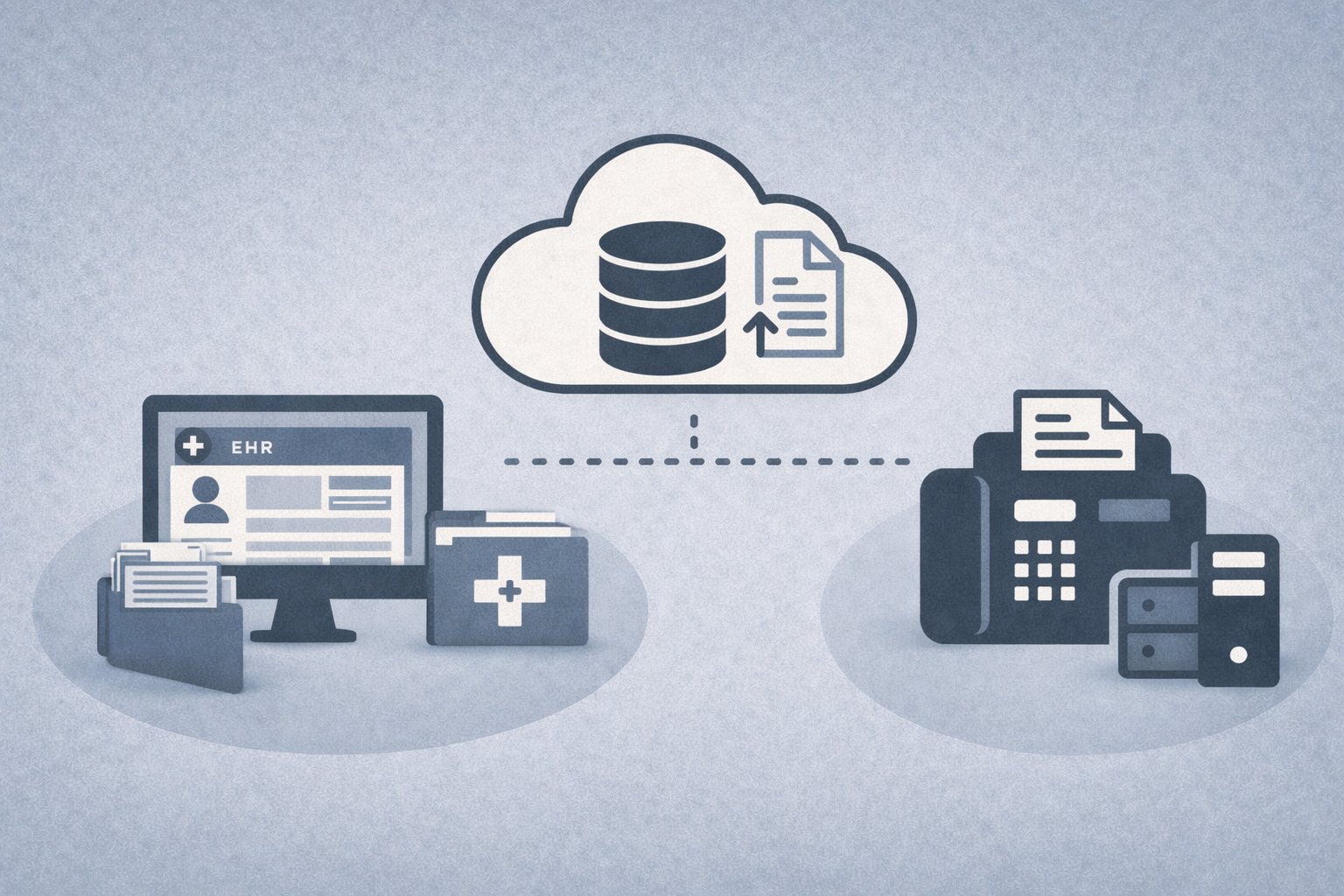
RightFax–EHR integration is an efficient way to communicate more quickly and securely.
Despite the shift to EMRs and EHRs, fax remains a critical channel for hospitals, payers, and less-connected providers. Many external partners still rely on fax for referrals, orders, and documentation.
RightFax–EHR integration modernizes these fax-dependent workflows without disrupting clinical routines. Fax moves directly into and out of the EHR, reducing manual handling while keeping users inside the systems they already rely on.
Fax persists because it is often the only secure channel every organization can receive without setup or coordination. Healthcare operates across a wide spectrum of technical maturity, so interoperability gaps remain common.
Unmanaged faxing also introduces unnecessary risk. Standalone fax machines offer limited access control and minimal audit visibility compared with modern clinical systems. Paper‑based workflows further slow care delivery as staff print, scan, upload, and manually route documents.
Integrating fax into the EHR removes these manual steps while maintaining compatibility with all external partners.
RightFax (OpenText Fax) is an enterprise fax platform that centralizes fax transmission, access control, and audit logging. When integrated with an EHR, it embeds fax directly into clinical workflows.
Users send and receive faxes within the EHR interface. Outbound documents originate from charts, orders, or administrative workflows. Inbound faxes are captured centrally and routed automatically to the appropriate chart, queue, or in‑basket using identifiers, routing rules, or document metadata.
Administrators manage numbers, routing rules, delivery status, and reporting from a centralized control layer.
In effect, RightFax integration turns fax from a loosely managed communication channel into a governed EHR capability.
RightFax supports common fax-based transactions while keeping clinicians and staff inside the EHR.
Clinicians can send referral packets, notes, orders, and authorization materials directly from the patient chart. Integration allows organizations to:
Inbound consults, external results, outside records, and payer correspondence can be captured and routed automatically. Identifiers, barcodes, or OCR‑based logic place documents in the correct chart or work queue, reducing manual scanning and misfiled records.
Many payers still require fax communication. Integrated fax shortens send‑receive cycles and improves tracking. Revenue cycle teams gain clearer visibility into submissions and defensible audit trails for payer interactions.
Integration removes printing, scanning, and physical document handling. Referrals, orders, and authorizations move faster with less variation across departments.
Consistent identifiers and routing rules improve chart accuracy. Administrators gain better visibility into permissions, routing activity, and document handling.
Users remain inside the EHR without switching tools or tracking fax status manually. Delivery indicators and automated routing reduce follow‑up calls and administrative friction.
If you want to explore how these benefits would apply in your environment, contact us to discuss your EHR and fax workflows with a senior consultant.
Integrated RightFax environments support role‑based access control, secure transmission paths, and detailed audit logging. These capabilities close common gaps found in standalone fax machines or lightly governed fax tools.
Clinical communication often depends on timely fax delivery. High‑availability deployments typically include redundant fax services, resilient SIP connectivity, and defined failover behavior. Automatic retries and delivery confirmations reduce the likelihood of missed transmissions.
Modern fax environments increasingly rely on SIP or cloud telephony. In hybrid or cloud architectures, routing boundaries and security controls between the EHR and fax infrastructure must be clearly defined.
Many organizations address these requirements through managed deployments such as Private Fax Cloud® while preserving existing EHR integrations.
Successful integrations typically follow a structured approach.
Inventory fax devices, numbers, user groups, and document types. Identify high‑volume workflows and areas where compliance or turnaround risk exists.
Prioritize use cases that deliver immediate value, such as referrals, prior authorizations, and inbound results. Establish measurable goals such as reduced manual scanning or faster processing times.
Select an integration model aligned with the EHR environment. Define routing rules, naming standards, monitoring processes, and operational ownership.
Provide role‑specific training and deploy the integration in phases. Monitor fax volumes, delivery performance, and turnaround times, then refine workflows based on real‑world usage.
Fax will remain part of healthcare communication for the foreseeable future. The goal is not to eliminate fax, but to manage it as a secure, efficient service integrated directly with the EHR.
If you want to evaluate how RightFax can integrate with your EHR environment, we’re here to help assess your current workflows, validate integration options, and design a deployment roadmap. Contact us to discuss your environment with a senior consultant.